
 EN
EN


The Math Behind the Magic: How Three Colors Become Millions
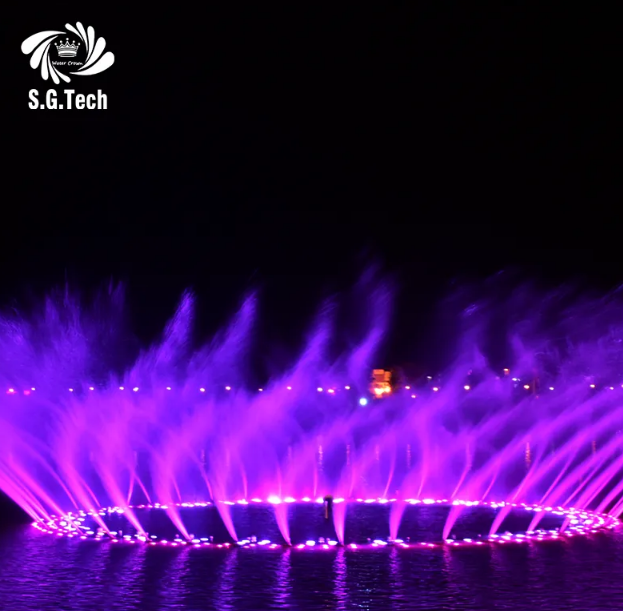
Stand at the edge of any major dancing fountain show—the ones at Dubai’s Burj Khalifa Lake, the Bellagio in Las Vegas, or Singapore’s Marina Bay—and watch the water shift from deep crimson to electric violet in a fraction of a second. That seamless transition isn’t sleight of hand. It’s straightforward color math executed at high speed.
RGB LED fixtures used in professional fountain applications contain three discrete light-emitting diodes: red, green, and blue. Each diode operates on an 8-bit control channel, meaning it can be dimmed to any of 256 intensity levels—from fully off (0) to maximum output (255). Multiply those three channels together: 256 × 256 × 256 = 16,777,216 distinct color possibilities. That’s the theoretical ceiling.
But theory and practice don’t always line up. Most fountain controllers cap usable combinations somewhere in the hundreds of thousands because the human eye can’t reliably distinguish between adjacent shades in the 16-million range. Still, even a conservative estimate of 200,000–300,000 perceivable colors gives show designers more palette than any painter ever had.
DMX512: The Backbone That Keeps Everything in Sync
Color potential means nothing without a control protocol that can distribute instructions reliably across dozens or hundreds of fixtures. That’s where DMX512 comes in. Originally developed for theatrical stage lighting in the 1980s, DMX has become the universal language for entertainment lighting—including fountain displays.
A DMX512 universe supports up to 512 individual control channels. A typical RGB fountain fixture consumes three channels (one per color). Some setups add a fourth channel for white or for master dimming, pushing consumption to four channels per fixture. A medium-sized fountain with 150 RGB lights requires 450 channels—well within one universe. Larger installations with hundreds of fixtures might run multiple universes over a daisy-chained RS-485 network.
The real challenge isn’t channel count—it’s timing. DMX refreshes at roughly 44 times per second. Each fixture receives its intensity values within that refresh window, meaning color changes happen fast enough that the human eye perceives smooth motion rather than discrete steps. That’s why a fountain can shift from a slow cyan-to-magenta wash to a strobing red-white-blue burst without visible lag.
Pre-Programmed Sequences vs. Real-Time Control
Fountain operators generally choose between two control approaches, and the decision shapes what the audience experiences.
| Control Approach | Strengths | Limitations |
|---|---|---|
| Pre-programmed sequences | Consistent performance, lower operator skill requirement, predictable timing | Fixed repertoire, less responsive to live events |
| Real-time DMX control | Infinite variation, music synchronization, interactive capabilities | Requires skilled programming, higher upfront setup cost |
Most commercial fountains run a hybrid model. The controller stores 18 to 24 pre-programmed sequences that cover the most common color combinations—gradual fades, rapid chases, crossfades between complementary colors. These sequences handle the bulk of a typical show. But for special events, holidays, or custom choreography, operators switch to live DMX control, often triggering color changes from a lighting console or even a MIDI interface synchronized with a musical score.
A 2023 industry survey of 47 commercial fountain installations found that venues using real-time DMX control reported 62% higher audience engagement scores during evening shows compared to those running only fixed sequences. The data suggests that variability—the sense that anything could happen next—keeps people watching longer.
The Role of Color Mixing Physics in Water
Here’s where things get counterintuitive. The RGB color model used in fountain lighting is additive—red, green, and blue light combine to create white when all three are at full intensity. But water isn’t a neutral medium. Depending on its chemical composition, turbidity, and the angle of refraction, water can absorb or scatter certain wavelengths more than others.
In practice, this means the color a designer selects on a console isn’t always the color the audience sees. A fountain with high mineral content—common in regions with hard groundwater—tends to shift blues toward green and reds toward orange. One installation in a Midwestern U.S. municipal park required a 15% compensation offset in the green channel just to make the fountain’s “pure white” setting look white rather than pale aqua.
Professional fountain engineers account for this during commissioning. They’ll run a calibration sequence—typically a ramp through the full RGB spectrum—while measuring the actual output with a spectroradiometer. The correction values get stored in the controller’s profile, ensuring that what the designer intends is what the audience actually sees.
A Real-World Installation: The Mall Fountain That Needed a Fix
A shopping mall in southern China opened a new dancing fountain in 2022. The developer specified 84 RGB LED fixtures with DMX control, expecting a vibrant nighttime attraction. Opening night looked promising—until the color transitions started. The fountain cycled through colors, but the transitions were jerky, and certain hues—particularly deep purples and bright oranges—looked washed out.
The engineering team traced the issue to two factors. First, the original controller was underpowered for the number of fixtures; it couldn’t process 252 DMX channels fast enough to maintain smooth fades. Second, the fountain’s water had a slight yellow tint from residual pipe corrosion, which absorbed blue light more than expected.
The fix involved swapping the controller for a higher-capacity unit and adding a custom color-correction profile. The team also installed a sediment filter to reduce turbidity. After recalibration, the fountain delivered clean transitions across the full spectrum. The mall reported a 40% increase in evening foot traffic to the fountain plaza over the following three months.
Limitations Even the Best Systems Can’t Overcome
For all the technical sophistication, RGB fountain lighting has genuine constraints. Ambient light is the biggest enemy. A fountain that looks spectacular at 9 PM can look completely washed out at 6 PM on a sunny day. The fixtures simply don’t have enough luminous intensity to compete with direct sunlight. That’s why most dancing fountains reserve their best color shows for after dusk.
Water quality also matters more than most spec sheets admit. High turbidity scatters light before it can reach the viewer’s eye, muting colors and reducing perceived brightness. And LED fixtures themselves have a finite lifespan—not in terms of sudden failure, but in gradual color shift. The red diode typically degrades faster than blue or green, meaning a fountain that started with balanced whites may develop a slight blue-green tint after several years of heavy use.
Regular maintenance—cleaning lenses, checking seals, and recalibrating color profiles—keeps these issues manageable. But expecting a fountain to look the same on year five as it did on day one isn’t realistic. The technology is robust, but it’s not magic.
What Separates Good Installations from Great Ones
The difference between a forgettable fountain and a memorable one often comes down to three decisions made long before the first nozzle is installed: fixture placement, color temperature planning, and redundancy.
Fixture placement determines whether color transitions appear smooth or choppy. Fixtures spaced too far apart create visible gaps in the color field. The industry standard recommendation is maximum 1.5-meter spacing for RGB fixtures in fountain applications, though tighter spacing produces better results.
Color temperature planning involves more than just RGB values. Many high-end installations now incorporate tunable white LEDs alongside RGB, giving designers the ability to adjust the warmth or coolness of white segments independently. This matters more than it sounds—a fountain that can shift from a warm golden-white to a cool ice-blue within the same show feels more dynamic than one limited to primary colors.
Redundancy means having backup fixtures and a secondary controller ready to go. Fountain shows don’t get rain delays—they run in rain, wind, and whatever else the weather delivers. Components fail. The best installations plan for it.
For fountain owners and specifiers looking for reliable equipment and manufacturing support, Guangdong Water Crown offers in-house production capabilities and ISO-certified quality control across its fountain lighting and control systems. Their experience with both standard and custom configurations makes them a practical choice for projects that demand consistent performance under real-world conditions.
Table of Contents
- The Math Behind the Magic: How Three Colors Become Millions
- DMX512: The Backbone That Keeps Everything in Sync
- Pre-Programmed Sequences vs. Real-Time Control
- The Role of Color Mixing Physics in Water
- A Real-World Installation: The Mall Fountain That Needed a Fix
- Limitations Even the Best Systems Can’t Overcome
- What Separates Good Installations from Great Ones