
 EN
EN


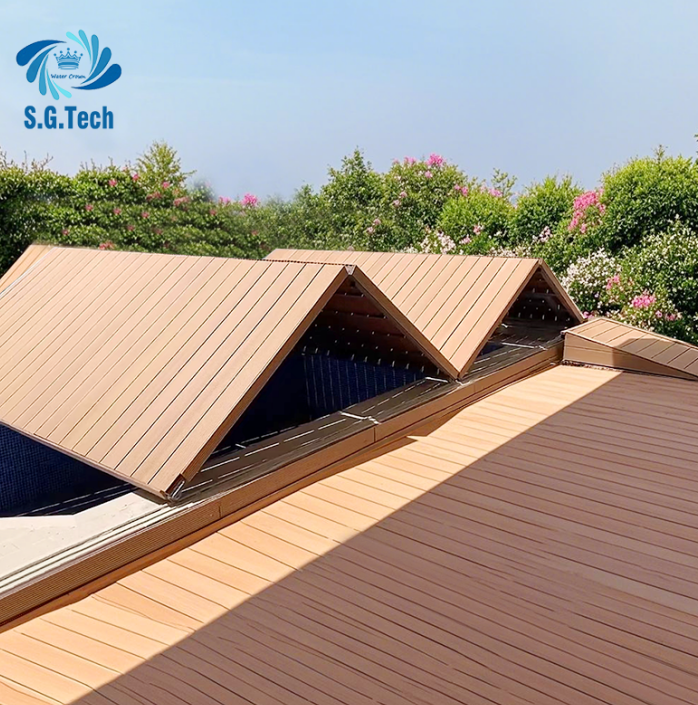
How Folding Pool Cover Mechanisms Maximize Space in Club Pools
The role of folding pool cover systems in optimizing space for commercial aquatic facilities
Folding pool covers really boost how efficiently space gets used in commercial pools because they swap out those big, complicated old systems for something smarter and much smaller. No more digging deep pits for storage, installing overhead tracks, or building special mechanical rooms just for cover storage. That frees up precious deck area where people actually want to hang out. The clever engineering behind these covers includes things like vertical stacking that packs them away into tiny shafts, plus modular pieces that fold together almost like origami. Some facilities have seen their stored footprint shrink by as much as two thirds compared to those old rolling or sliding covers. Real world results show aquatic centers typically gain about 40% more usable space on their decks. One facility manager told me they were able to add extra loungers and even host small events right there on the deck without having to expand the whole building.
Engineering principles behind compact deployment of folding pool covers
Getting the most out of available space comes down to smart mechanical design and good material choices. Aluminum parts connected with precision pivot joints allow for consistent movement patterns both when opening and closing the cover. Engineers use computer simulations to work out the best shapes for these frames so they don't break under stress but still pack away really small. Some top models take up less than 10% of the pool surface when folded up completely. What's interesting is that installation needs just about 6 inches of side space now, which means these foldable covers can actually fit into older pools where there wasn't enough room before for any kind of covering at all.
Case study: Space efficiency gains at a 25-meter club pool using folding pool cover technology
When Oakwood Swim Club installed their folding pool cover system back in 2023, they gained quite a bit of extra space around the pool area. Before this upgrade, the old cover took up about 3.5 meters along the side of the deck, which basically swallowed up what could have been a nice spot for people to hang out. With the new folding system in place, that footprint shrunk down to only 0.8 meters, freeing up roughly 310 square feet of valuable deck real estate that members can now actually use for lounging and socializing instead of being blocked off by equipment.
| Parameter | Before Installation | After Installation |
|---|---|---|
| Lateral Space Used | 3.5m | 0.8m |
| Deployment Time | 22 minutes | 4 minutes |
| Annual Maintenance Hours | 80 hours | 18 hours |
Beyond space, the system cut water evaporation by 92% (Aquatic Facility Quarterly, 2024), and the recovered area was converted into a revenue-generating lounge—proving that compact cover design delivers measurable ROI in both operational efficiency and facility versatility.
Types of Folding Pool Covers: Retractable vs. Modular Systems for Space-Conscious Clubs
Retractable folding pool covers: Footprint, automation, and space efficiency
Folding covers that retract are great for saving space since they slide back along tracks into compact housings right at deck level, usually taking up less than four feet of depth. With motorized rollers doing most of the work, there's no need for people to manually handle them or set up extra equipment around the pool area. These systems work best when installed on pools that have straight edges without obstacles getting in the way. They take up far less space compared to other commercial folding cover options available today, making them particularly popular for facilities where every inch counts.
Modular folding pool covers: Flexibility and compact storage advantages
Modular systems consist of separate panels connected by hinges that fold together like an accordion into vertical stacks. These take up less than 25% of the pool surface area when stored away. Because they stand on their own rather than being built into the structure, these systems work great for older pools or ones with odd shapes. There's no need for special tracks buried in the ground, just attach them right onto whatever deck already exists around the pool area. The flexibility means pool clubs can get complete coverage without dealing with the headaches of modifying traditional sliding systems that often cost too much money and cause structural problems during installation.
Material innovations enhancing space-saving performance in folding pool covers
The use of lightweight yet strong materials is really pushing forward improvements in space efficiency for pool covers. Take these advanced laminated fabrics that weigh less than 0.8 pounds per square foot when paired with composite frames. According to the 2024 Pool Tech Report, this combination cuts down on overall cover weight by around 40%. That means manufacturers can install smaller motors, design narrower track systems, and achieve much tighter fold radii. What's more, special UV resistant polymer coatings stop thermal expansion issues, so the covers maintain their shape throughout different seasons and folds consistently every time. And let's not forget about those aerodynamic fabric shapes which make a big difference too. They significantly cut down on how much space the cover takes up when deployed, needing about 30% less room sideways compared to regular vinyl options. This matters a lot for pools installed in areas where deck space is at a premium.
Key space optimization features compared:
| Feature | Retractable Systems | Modular Systems |
|---|---|---|
| Storage Footprint | Linear housing (<4ft deep) | Vertical stack |
| Install Flexibility | Requires straight tracks | Adapts to curved decks |
| Material Advantage | Low-profile rollers | Fold-resistant joints |
Installation Trends and Space-Smart Design in Modern Folding Pool Cover Systems
2024 trends: New folding pool cover models reducing lateral and peripheral space needs
Today’s most space-conscious systems prioritize architectural integration over mechanical compromise. Two defining trends dominate 2024 installations:
- Vertical stacking mechanisms, now standard in premium models, cut lateral space requirements by 40% compared to 2022 equivalents (Aquatic Facility Standards 2024);
- Peripheral track elimination, enabled by magnetic guidance systems, removes the need for boundary-mounted rails or curb-integrated infrastructure.
These innovations allow covers to be housed in previously unusable spaces—such as recessed niches beside pump rooms, beneath stair landings, or within planter walls—without compromising reliability or coverage integrity.
Balancing safety compliance with minimal space use in folding pool cover installations
Today's folding covers actually hit those ISO 13482 safety marks even though they're pretty small packages. No need to compromise anything else for safety here. The track system sits low to the ground and cuts down on overall width by about a third, so people aren't tripping over them anymore but still carry heavy stuff across just fine. Water drains off these covers through hidden channels that don't take up any extra room on decks or platforms, which helps prevent slips and falls especially when it rains. When weight is applied, the segments lock automatically without needing special hardware or boxes around them, meeting all structural needs while keeping the surface smooth and continuous. Bright edge indicators and sensors that stop movement when pressure changes are part of the design from day one rather than bolted on later, making sure both safety features work together naturally without taking up precious floor space.