
 EN
EN


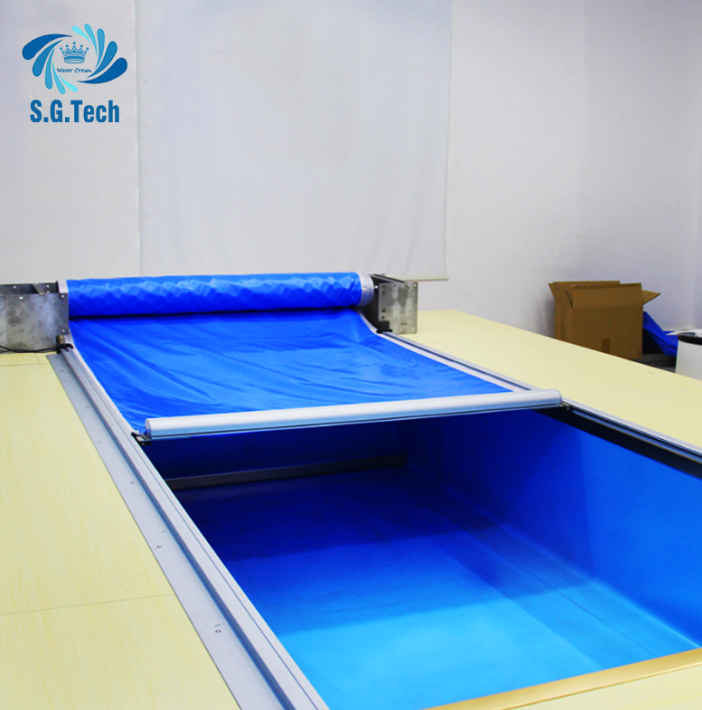
Enhanced Safety: Preventing Accidents and Meeting ASTM F1346-23 Standards
Automatic Pool Cover as a Physical Barrier Against Falls
Modern automatic pool covers create a continuous safety barrier capable of supporting over 485 lbs, meeting the ASTM F1346-23 standard for static load resistance. Unlike mesh covers that permit water seepage, these rigid systems evenly distribute weight across the pool surface, providing reliable protection against accidental submersion.
Compliance With ASTM F1346-23 Safety Certification
To achieve ASTM F1346-23 safety certification, covers must pass three key tests:
- Perimeter deflection: Gaps between the cover and pool edge must not exceed 4 inches under 25 lbs of force
- Surface drainage: Covers must shed 97% of standing water within 30 minutes
- Entrapment resistance: No openings wider than 3 inches when tested with a 5.5“ spherical probe
Structural Integrity and Weight-Bearing Capacity
Constructed with high-grade aluminum tracks and industrial-strength slats, automatic covers resist environmental stressors such as snow loads (up to 150 lbs/sq ft) and prolonged UV exposure. Leading models maintain full functionality for 15+ years with routine maintenance, ensuring long-term reliability.
Protecting Children, Pets, and Unauthorized Users
Automatic covers reduce drowning risks by 83% in homes with young children (Pool Safety Council 2022). Motorized operation via secure keypads or smartphone apps eliminates manual handling errors, while tamper-resistant designs prevent access by pets or unauthorized users.
Debris Protection and Reduced Maintenance with Automatic Pool Cover Systems
Keeping out leaves, dirt, and airborne contaminants
Automatic pool covers keep out around 95% of stuff that falls into pools naturally, like leaves and bits of grass. They actually seal those tiny spaces between panels that are smaller than 1/8 inch, which stops dust from getting in too. Most pool owners notice they spend way less time cleaning their skimmer baskets now. Some studies from last year showed people were cutting down on this chore by anywhere between 60 to 80 percent when they switched to covered pools. The materials used for these covers are either vinyl or some sort of reinforced fabric. These materials follow specific industry standards called ASTM F1346-23 regarding how well they stop small particles. And guess what? They work pretty good against things like pollen grains that measure somewhere between 15 and 25 microns across.
Track system options: recessed, surface-mount, and under-deck
Three track configurations optimize debris protection based on installation type:
| System Type | Debris Protection Rating | Ideal For |
|---|---|---|
| Recessed | 98% | New constructions |
| Surface-mount | 92% | Retrofits |
| Under-deck | 95% | Composite/stone decking |
Recessed tracks offer the tightest seal by embedding guide rails below the deck surface, while under-deck models use specialized gaskets to prevent dirt buildup in concealed channels.
Impact on filter runtime and cleaning frequency
Research conducted in 2024 looked at 120 home pools and discovered something interesting about those who used automatic covers. People with these covers ran their pool filters about 35 to 40 percent less each day, which translated into savings of around $18 to $22 monthly on electricity bills. According to findings from what they called the Filtration Efficiency Study, cartridge filters needed cleaning much less frequently too – instead of every two weeks, they lasted six weeks between cleanings. Sand filters saw even bigger improvements, needing backwashing only about a quarter as often as before. The bottom line? Pool pumps in covered installations tend to last roughly twice as long because there's simply less strain on them over time.
Energy Efficiency and Heat Retention for Lower Operating Costs
How Automatic Pool Covers Reduce Heat Loss and Evaporation
Automatic pool covers work like a thermal shield, stopping heat from escaping through both evaporation and air movement. Think of them as similar to those thick layers of insulation used in buildings - they basically hold onto the warmth right where it matters most, at the water surface. Most people find that their pools stay warmer overnight when covered, sometimes cutting down temperature losses by around 70%. And there's another benefit too. These covers dramatically reduce how much water evaporates during the day, often bringing evaporation rates down close to 90% compared to what happens with no cover at all. This means less moisture hanging around the house or garage near the pool area, which actually helps save on energy bills because there's less need for dehumidification systems to kick in constantly.
Monthly Savings on Heating and Water Replacement
Under temperate climate conditions, the heating demand for covered swimming pools has decreased by 50-65%, and by limiting evaporation, the annual water replacement demand has decreased by 30-50%. This also reduces the consumption of chemicals. For gas heated swimming pools, it can save $150-300 per month during peak season, and the efficiency of the heat pump system is even higher.
Energy Performance in Residential Pools
A 2022 analysis of 82 homes revealed that pools with automatic covers needed 37% less heater runtime than uncovered pools. In a Michigan case study, a covered pool maintained 82 degrees Fahrenheit (28 degrees Celsius) with 41% less energy than those using manual covers, achieving full return on investment in under three years through energy conservation.
Chemical Preservation and UV Protection to Maintain Water Balance
Reducing Chlorine Degradation from Sunlight Exposure
Automatic pool covers block 95% of UV radiation, preventing sunlight from breaking down chlorine. This helps maintain stable free chlorine levels and reduces the need for daily chemical adjustments. Uncovered pools can lose up to 70% of chlorine to UV degradation within 24 hours during summer months (International Pool & Spa Association, 2023).
Extending Chemical Lifespan and Minimizing Dosage Needs
By protecting water from UV rays and pollutants, the automatic lid extends the effectiveness of chlorine by 2-3 days, reducing chemical costs by 35-50% annually. Stable chlorine levels also reduce pH fluctuations caused by frequent dosing.
Lower Maintenance Costs and More Stable Pool Chemistry
The combined benefits of UV and debris protection lead to:
- Chlorine and algae removal agents save $180 to $600 annually
- Reduce pH adjustment by 40%
- Consistent disinfectant level (± 0.5 ppm vs. ± 2.0 ppm in uncovered pools)
These improvements simplify maintenance and help prevent issues like algae blooms or corrosive water conditions.
Smart Operation and Convenience with Motorized Control Systems
One-touch opening and closing via remote or app
Modern automatic pool covers are equipped with wireless remote controls or smartphone applications, replacing manual activation with instant deployment. The lid can be opened or retracted in seconds - even indoors - making them an ideal choice in sudden weather changes. This seamless control reflects the principle of intelligent motor controllers, which focuses on user centered automation in residential environments.
Integrated security: key switches, PIN codes, and smart home compatibility
The high-end models include physical key switches and programmable PIN codes to prevent unauthorized use. Many features are integrated with Alexa, Google Home, or Apple HomeKit, supporting voice commands and automated programs such as' closing doors at sunset '. These features apply industrial grade automation safety concepts, improving consumer safety without sacrificing convenience.
Maximizing usability across seasons with automated convenience
Automatic covers make winterizing much easier since they stop snow from building up on top, and during summer months the system can be set to close at noon regularly to cut down on water loss. When strong winds blow or something gets in the way, built in sensors just shut things down automatically, so it adjusts itself throughout different seasons without anyone needing to do anything. The smart automated features actually save around 30 to 40 percent on parts wear and tear when compared with older manual systems, which means fewer repairs over time.
Table of Contents
- Enhanced Safety: Preventing Accidents and Meeting ASTM F1346-23 Standards
- Debris Protection and Reduced Maintenance with Automatic Pool Cover Systems
- Keeping out leaves, dirt, and airborne contaminants
- Track system options: recessed, surface-mount, and under-deck
- Impact on filter runtime and cleaning frequency
- Energy Efficiency and Heat Retention for Lower Operating Costs
- Chemical Preservation and UV Protection to Maintain Water Balance
- Smart Operation and Convenience with Motorized Control Systems