
 EN
EN


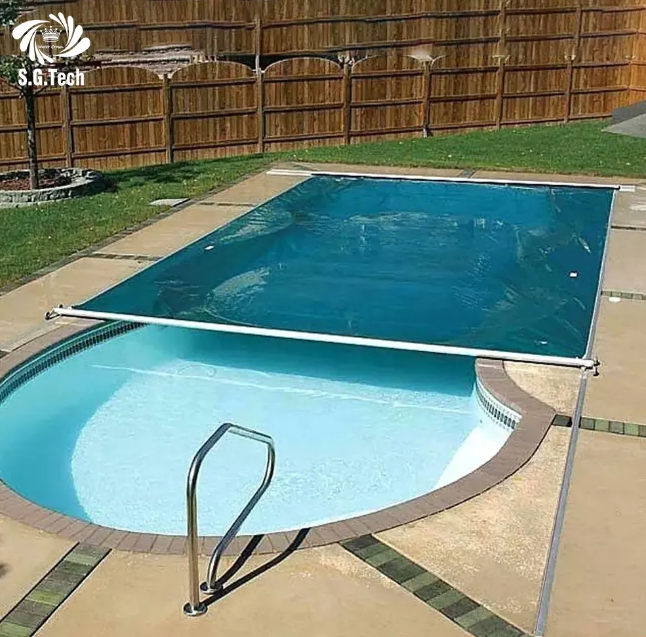
Why Pool Covers Do More Than Just Block Debris
A lot of pool owners treat covers as a seasonal afterthought, something to throw on before a vacation or before winter sets in. That framing misses the bigger picture. An automatic solar pool cover operates as an active thermal management layer, and the physics behind it explain why it consistently outperforms passive alternatives across multiple performance categories.
The core mechanism is straightforward: solar-grade polycarbonate or air-bubble polyethylene traps infrared radiation during daylight hours and creates an insulating air gap that slows nighttime heat loss. According to ASHRAE Standard 90.1 guidance on aquatic facility energy use, uncovered outdoor pools lose between 50% and 70% of their heat energy through surface evaporation alone. A well-fitted solar cover cuts that loss dramatically, though exact figures depend on climate, pool geometry, and cover material.
What the Thermal Physics Actually Look Like
Heat moves through three channels in an outdoor pool: evaporation, convection, and radiation. Evaporation is by far the dominant path, accounting for roughly 70% of total heat loss under moderate ambient conditions. When water molecules at the surface escape into the air, they carry latent heat with them at a rate proportional to wind speed and the vapor pressure differential between the water surface and the atmosphere above it.
A solar cover suppresses this by sealing off the air-water interface. Even a thin polyethylene bubble cover reduces evaporative loss by 95% or more during covered hours. The air pockets within the cover material add an R-value layer, typically R-1.5 to R-2.0 for standard bubble designs, that slows conductive heat exchange with cooler air overnight.
Comparing Cover Types: Where Automatic Systems Earn Their Place
Manual covers require poolside storage, physical effort to deploy, and carry a real risk of inconsistent use. Automatic retractable systems address all three of those friction points.
| Cover Type | Evaporation Reduction | Thermal Gain Capability | Ease of Daily Use | Approximate Lifespan |
|---|---|---|---|---|
| Basic bubble sheet (manual) | 90-95% | Moderate | Low | 2-4 years |
| Foam-core thermal cover | 85-90% | High | Low | 4-6 years |
| Automatic bubble/PC cover | 90-95% | Moderate to High | Very High | 5-10 years |
| Liquid solar cover | 50-60% | Low | Very High | N/A (consumable) |
| No cover | 0% | None | N/A | N/A |
The automatic form factor matters because it removes the behavioral barrier. A cover that takes two minutes to deploy and retract gets used every day. One that requires storage, unrolling, and physical handling often ends up in the garage by mid-July.
Solar Heating as a Free Energy Input
Beyond heat retention, bubble and polycarbonate covers actively harvest solar energy. UV-transparent materials allow short-wave radiation to pass through into the water column, where it is absorbed and converted to heat. This passive solar gain can raise pool temperature by 4 to 8 degrees Fahrenheit on a sunny day, depending on cover transmissivity and sun angle.
A project at a private residential pool complex in the Florida Gulf Coast region tested this directly. The facility had been running gas heating year-round to maintain a target temperature of 84 degrees Fahrenheit. After installing an automatic polycarbonate cover system, the heating demand dropped enough to allow the gas heater to be switched off entirely for approximately five months of the year. The cover was doing the thermal work during daylight hours and holding that heat through the overnight period.
Chemical and Water Balance Implications
Solar covers do affect water chemistry, and this is worth accounting for during installation planning. Reduced evaporation means less need for water top-offs, which in turn means less dilution of dissolved solids, hardness, and stabilizer. Pools running covers full-time tend to see cyanuric acid levels climb faster than uncovered pools.
The standard practice is to test water chemistry more frequently during high-cover-use periods and to budget for slightly more aggressive backwashing or partial drains to manage total dissolved solids. These are manageable tradeoffs, not deal-breakers, but ignoring them creates maintenance headaches down the line.
Automation Hardware and Integration Points
Modern automatic pool cover systems use either a tubular motor drive or a rack-and-pinion track mechanism to extend and retract the cover across the pool surface. Control options range from wall-mounted key switches to smartphone-connected touchscreen panels that allow timer scheduling and remote operation.
The mechanical housing design matters for long-term reliability. Systems housed in weatherproof aluminum enclosures with sealed motor compartments hold up better in outdoor environments than those with exposed hardware. Pool shape also affects system selection: rectangular pools work with straightforward track systems, while irregular or kidney-shaped pools typically require a custom-fabricated cover to match the contour.
Water Crown designs and manufactures automatic solar pool cover systems built around exactly these real-world deployment requirements, with polycarbonate options suited to both residential and commercial scale installations and track configurations adaptable to non-standard pool geometries.