
 EN
EN



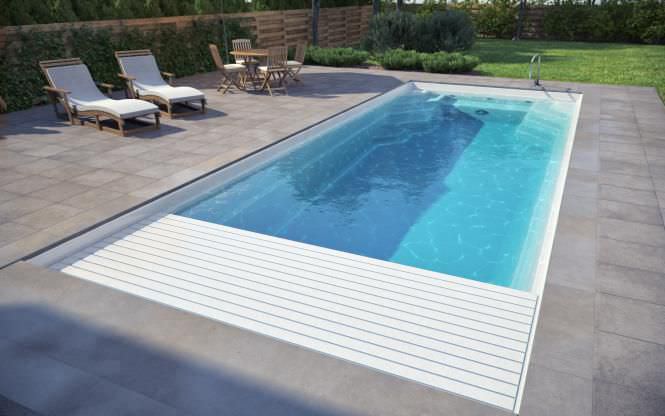
The Real Cost of a Pool Cover Isn't the Price Tag
Here's a question that comes up in almost every commercial pool project: why would anyone pay more for a polycarbonate automatic cover when a vinyl or mesh option costs significantly less? The answer isn't about first cost. It's about total cost of ownership over a five- to ten-year horizon, and that's where the math starts to look very different.
Polycarbonate slats combine a visually premium appearance with structural strength that outperforms most alternatives. The material's impact resistance means it can handle hail, falling branches, and the general wear that comes with daily operation in exposed environments. More importantly, UV-stabilized polycarbonate resists the yellowing and embrittlement that plagues standard plastics after a few seasons of direct sunlight.
The automatic pool cover market has seen a clear shift toward polycarbonate in recent years, particularly in hospitality and multi-family residential projects where durability directly affects operating budgets. A cover that needs replacement every four to five years versus one that lasts eight to ten years changes the financial picture entirely.
Breaking Down What "Durability" Actually Means in This Context
Durability isn't one thing. It's a bundle of properties, and polycarbonate delivers on several fronts simultaneously.
Impact resistance comes first. Polycarbonate is roughly 250 times stronger than glass and significantly more impact-resistant than acrylic or PVC. That matters when a cover is subjected to accidental drops of pool equipment, children running across it, or seasonal debris like acorns and small branches. The material doesn't shatter or crack easily. It deforms slightly under load and returns to shape.
UV resistance is the second critical factor. Unprotected polycarbonate will degrade over time—yellowing, losing impact strength, becoming brittle. But modern manufacturing adds UV-stabilizing layers that extend service life substantially. Some premium polycarbonate sheets used in pool cover applications come with UV protection guarantees extending beyond ten years. That's not marketing fluff; it's a material science reality.
Chemical resistance matters too, especially in commercial pools with aggressive chlorine and bromine treatments. Polycarbonate holds up well against common pool chemicals, unlike some metals that corrode or other plastics that soften and warp. The slatted design of automatic polycarbonate covers also means water doesn't pool on top—it drains through the gaps or runs off the edges, reducing chemical exposure and standing water weight.
A Commercial Property Case Study
A mid-sized hotel chain in the southwestern United States operates eight properties with outdoor pools. Until about four years ago, they used vinyl automatic covers across the portfolio. The pattern was consistent: year three showed visible stretching and sagging; year four required patching; year five meant replacement. Each replacement ran into five figures per pool, plus the operational disruption of having the pool out of service during installation.
The chain tested polycarbonate covers on two properties as a pilot. The initial cost was higher—roughly 30 to 40 percent more than vinyl—but the properties are now entering their fifth year with no visible degradation, no sagging, and no repairs. The maintenance staff reports that the covers clean more easily and show no signs of the UV damage that had become routine with vinyl.
The chain is now converting the remaining properties. The payback period, factoring in avoided replacement costs and reduced maintenance hours, worked out to roughly 2.5 years. Everything after that is savings.
Safety Standards and What They Require
ASTM F1346-23 establishes the performance requirements for safety covers used on swimming pools, spas, and hot tubs. The standard specifies load-bearing capacity, labeling requirements, and testing protocols that covers must pass to be considered safety covers. ASTM F1346-91 (2010) remains a commonly referenced benchmark, and many manufacturers design to meet or exceed these requirements.
Polycarbonate covers typically exceed the standard's requirements without special reinforcement. The material's inherent strength means the cover can support the required loads while maintaining a relatively lightweight profile. That's a meaningful advantage over steel-reinforced vinyl or heavy-gauge mesh systems, which require more robust track systems and more powerful drive motors.
The safety aspect isn't just about load-bearing. A cover that stays flat and taut across the pool surface—no sagging, no gaps at the edges—provides better protection against accidental falls. Polycarbonate's dimensional stability means it maintains that taut fit over years of thermal cycling, unlike materials that expand and contract more dramatically with temperature changes.
| Durability Factor | Vinyl/ PVC Covers | Polycarbonate Covers |
|---|---|---|
| Impact resistance | Moderate; prone to tearing | High; resists cracking and shattering |
| UV resistance | Degrades within 3-5 years | UV-stabilized; 8-10+ year lifespan |
| Chemical resistance | Good but can soften | Excellent; maintains structural integrity |
| Dimensional stability | Stretches and sags over time | Maintains shape across temperature cycles |
| Typical replacement cycle | 4-6 years | 8-12 years |
Where Polycarbonate Covers Make the Most Sense
Not every pool needs polycarbonate. A small residential pool in a mild climate, used seasonally, might do perfectly well with a high-quality vinyl cover. The extra expense of polycarbonate wouldn't pay back within the owner's typical time horizon.
The value proposition shifts in specific contexts. Commercial pools that operate year-round benefit from the extended replacement cycle. Pools in areas with harsh winters—where freeze-thaw cycles put stress on cover materials—see clear advantages from polycarbonate's dimensional stability. Properties in high-UV regions, like the desert Southwest or Mediterranean climates, get direct ROI from the UV resistance.
Hotels and resorts also benefit from the aesthetic factor. Polycarbonate slats are available in finishes that complement contemporary architecture, and the material can be translucent, allowing natural light to penetrate while the pool is covered. That's a detail that matters when the pool area is a visible part of the property's guest experience.
The Limitations Worth Acknowledging
Polycarbonate covers aren't perfect, and pretending otherwise undermines credibility.
The upfront cost is real. For a budget-constrained residential project, the premium might be hard to justify. The payback exists, but it takes time, and not every owner plans to stay in the property long enough to realize it.
Repair complexity is another consideration. Vinyl covers can often be patched in place. Polycarbonate slats that sustain damage typically require replacement of the individual slat, which means accessing the mechanism and potentially removing adjacent slats. It's not a major operation, but it's more involved than a patch job.
Weight can also be a factor, though less so than with glass or acrylic alternatives. Polycarbonate is lighter than acrylic—roughly 30 percent lighter by some comparisons—but heavier than vinyl. The drive system needs to be spec'd accordingly, and the track system needs to handle the additional load over the cover's lifetime.
The Manufacturing and Quality Control Dimension
The difference between a polycarbonate cover that lasts eight years and one that fails in five often comes down to manufacturing quality. Not all polycarbonate is the same. The UV stabilizer package, the co-extrusion process, and the quality of the slat interlocking mechanism all affect real-world performance.
Manufacturers with ISO and CE certifications operate under quality management systems that provide traceability and consistency. That matters because polycarbonate's performance depends on precise material formulation and consistent production conditions. A cover from a certified facility is less likely to have hidden defects—micro-cracks, inconsistent wall thickness, or inadequate UV stabilization—that manifest years down the line.
Guangdong Water Crown has been manufacturing pool equipment and water feature systems with these certifications in place, giving them the production infrastructure to deliver polycarbonate covers that meet the demands of commercial and high-end residential applications. The combination of material science understanding and quality control systems is what separates covers that last from covers that don't.
Table of Contents
- The Real Cost of a Pool Cover Isn't the Price Tag
- Breaking Down What "Durability" Actually Means in This Context
- A Commercial Property Case Study
- Safety Standards and What They Require
- Where Polycarbonate Covers Make the Most Sense
- The Limitations Worth Acknowledging
- The Manufacturing and Quality Control Dimension