
 EN
EN



The Fence Alternative That Actually Seals the Threat
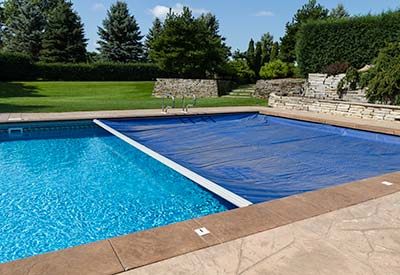
For years, the standard answer to pool safety has been a fence. Four feet tall, self-closing gate, no gaps bigger than four inches. But fences have a blind spot—they keep people out of the yard, not out of the water. Once a child or pet gets past the gate, the pool is still wide open. An automatic pool cover takes a different approach: it seals the water itself. When closed and locked, an ASTM F1346-certified automatic cover creates a rigid barrier designed to support at least 485 pounds and prevent unsupervised access by young children. That is not a passive deterrent. That is a physical blockade.
What ASTM F1346 Actually Tests For
The ASTM F1346 standard—formally titled the Standard Performance Specification for Safety Covers and Labeling Requirements for All Covers for Swimming Pools, Spas and Hot Tubs—establishes specific performance requirements. The static load test is the headline: the cover must support 485 pounds distributed over one square foot each, all within a three-foot radius, without allowing any test object to pass through. That is roughly the weight of two adults and a child. The standard also requires that the cover be free of any holes that would allow a child to fall through. Drainage systems must prevent water from pooling on top, because standing water creates both a drowning hazard and a weight issue. These are not suggestions. These are pass-fail criteria. A cover either meets them or it does not.
Where Building Codes Have Started to Shift
The International Swimming Pool and Spa Code (ISPSC) now allows ASTM-compliant powered safety covers to substitute for fencing in some jurisdictions. Connecticut adopted rules in 2022 allowing automatic ASTM-compliant pool covers to satisfy residential pool barrier requirements without fencing. Some municipalities have gone further—Strongsville, Ohio, already permits retractable safety covers in place of fences. But adoption is uneven. A 2026 case in Stow, Ohio, highlighted the gap: a homeowner argued that his motorized cover provided better protection than a fence, while the city's code, written years earlier, still mandated fencing. The hearing officer had to weigh a national standard against a local ordinance written before the technology existed.
The Real-World Performance Gap: Fences vs. Covers
Fences and automatic covers address different failure modes. A fence fails when a gate is left unlatched, when a child climbs over, or when a pet digs under. An automatic cover fails—if it fails at all—when the track is obstructed or the motor malfunctions. But those are mechanical failures, not behavioral ones. And mechanical failures can be mitigated with regular inspection. Behavioral failures are harder to fix.
| Safety Measure | Primary Failure Mode | ASTM Certification Required | Can Be Bypassed by Climbing |
|---|---|---|---|
| Perimeter Fence | Gate left open, climbing, digging | No | Yes |
| Manual Safety Cover | Improper installation, user error | Yes (if ASTM-compliant) | No |
| Automatic Pool Cover | Mechanical/electrical failure | Yes (F1346) | No |
The key distinction is that an automatic cover does not rely on the user to remember to close a gate. It relies on the user to press a button—and even that can be automated with timers or remote controls. Once closed, the cover creates a continuous surface that cannot be climbed over or squeezed through.
One Installation That Changed a Family's Risk Profile
A residential project in the southeastern U.S. involved a backyard pool with a six-foot wooden fence and a self-latching gate. The homeowner had two children under five and a dog that had learned to nudge the gate open. After two close calls—the dog got into the pool area twice in one summer—the owner installed an automatic cover with a key-locked control switch. The cover required a four-digit code to operate. Within a month, the dog had stopped trying to access the pool area entirely. The children could not operate the cover without the code. The fence remained, but the cover became the primary barrier. That layered approach—fence plus cover—is exactly what safety agencies recommend. No single measure is foolproof, but the combination changes the risk calculus.
The Limitations That Matter
Automatic covers are not a set-it-and-forget-it solution. They require a flat, straight pool shape to run tracks properly—freeform or heavily curved pools can accommodate them, but installation gets more complex and expensive. The cover must be closed and locked to function as a barrier; an open cover offers no protection. Power outages can leave the cover stuck in whatever position it was in when the power went out, though many systems include manual override options. And while the ASTM standard requires the cover to support significant weight, it does not guarantee that a child or pet cannot become trapped under the cover if they enter the water while the cover is being closed. That is why the U.S. Consumer Product Safety Commission recommends multiple layers of protection, not just one.
Why the Manufacturing Behind the Cover Matters
An ASTM-certified cover is only as good as its fabrication. The vinyl reinforcement, the track alignment, the motor assembly, the control system—every component has to be engineered to hold up under repeated use, weather exposure, and the occasional accidental load. Guangdong Water Crown Environmental Technology has been producing pool equipment and fountain systems since 2011, with a manufacturing operation that turns out hundreds of units per month. That kind of production scale demands consistent quality control, because a cover that fails a static load test in the field is a cover that never should have left the factory. For buyers, the question is not just whether a cover is ASTM-certified, but whether the manufacturer has the production discipline to deliver that certification consistently.
Table of Contents
- The Fence Alternative That Actually Seals the Threat
- What ASTM F1346 Actually Tests For
- Where Building Codes Have Started to Shift
- The Real-World Performance Gap: Fences vs. Covers
- One Installation That Changed a Family's Risk Profile
- The Limitations That Matter
- Why the Manufacturing Behind the Cover Matters