
 EN
EN



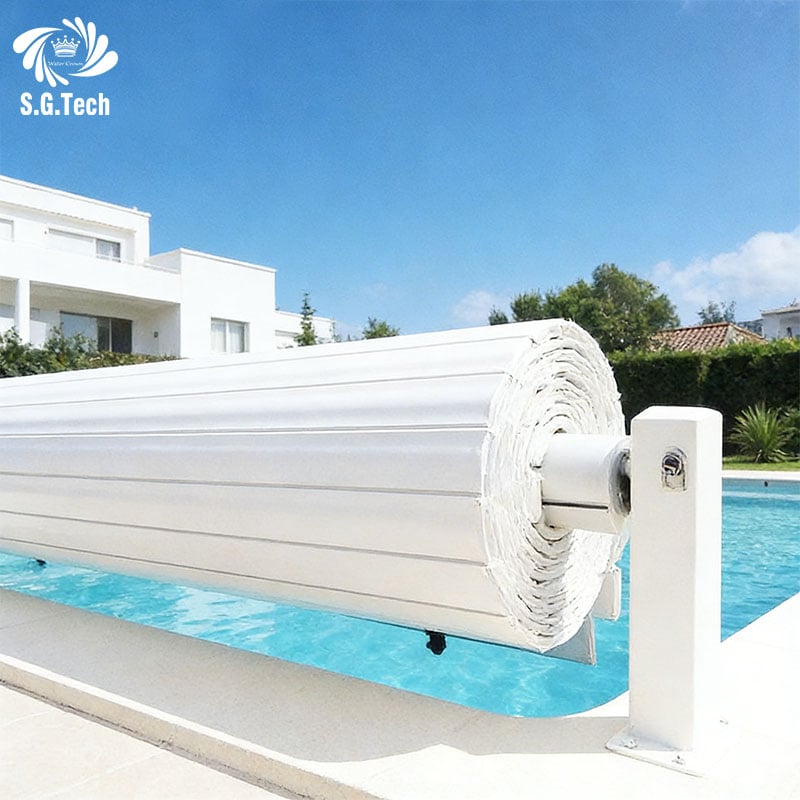
The Growing Demand for Motorized Pool Covers
The automatic pool cover market has seen steady growth over the past decade, driven by two converging trends: rising energy costs and stricter safety regulations. Pool owners and facility managers are discovering that a motorized cover does more than just keep leaves out. It cuts evaporation by 70 percent or more, retains heat, reduces chemical consumption, and most importantly, creates a safety barrier that meets or exceeds ASTM F1346-91 standards for load-bearing capacity.
But the market has also become crowded. A quick search returns dozens of manufacturers, each claiming superior quality, better pricing, or faster delivery. Sorting through the noise requires a systematic approach. What separates a reliable automatic pool cover manufacturer from one that cuts corners? The answer lies in manufacturing precision, material selection, control system integration, and track record with real installations.
Understanding What "Reliable" Actually Means in This Context
Reliability in automatic pool covers breaks down into three distinct categories: mechanical durability, electrical safety, and long-term weather resistance. Each category carries its own set of failure modes. Mechanical failures usually involve the drive mechanism—gears stripping, cables snapping, or tracks binding. Electrical failures range from control board malfunctions to motor burnout. Weather resistance failures show up as fabric degradation, seal breakdown, or corrosion of metal components.
The industry standard for structural integrity requires covers to support a minimum of 480 pounds per square foot. That's not an arbitrary number—it reflects the weight of a person plus the dynamic load of someone falling or jumping onto the cover. Manufacturers that consistently meet this standard invest in proper material testing and quality control protocols. CE certification for electrical components adds another layer of assurance, covering everything from motor insulation to remote control frequency compliance.
A 2025 industry procurement guide highlighted that buyers should confirm supplier adherence to these international standards before placing orders. The guide also noted that manufacturers offering customizable solutions—rather than one-size-fits-all products—tend to have better engineering capabilities and more responsive support teams.
Critical Components That Define Cover Performance
The cover fabric itself is the most visible component, but it's not the most critical. The drive system determines whether the cover opens and closes smoothly over years of use. DC motors with planetary gear reductions offer better torque control and longer service life than AC motors with simple worm drives. The difference shows up in field performance: a well-specified DC system handles off-center loads and minor track misalignments without jamming, while an AC system tends to bind under the same conditions.
Track systems deserve equal attention. Aluminum extrusions with stainless steel inserts resist corrosion better than plain aluminum or galvanized steel. In coastal installations, the difference becomes apparent within two years—corrosion on substandard tracks leads to binding, which strains the motor and eventually causes failure. One resort project in the Maldives replaced its entire track system after eighteen months because the original supplier used untreated aluminum. The replacement tracks, specified with marine-grade anodizing and stainless inserts, have been running without issues for over four years.
Control systems have evolved significantly. Modern automatic pool covers offer remote operation, smartphone integration, and in some cases, voice control. But the real differentiator is the safety logic built into the controller. Reliable systems include obstruction detection—the cover stops and reverses if it encounters resistance during closing. They also include manual override options for power outages, typically a hand-crank mechanism that doesn't require specialized tools.
Comparing Manufacturing Approaches and Their Outcomes
| Evaluation Criteria | Low-Tier Manufacturer | Mid-Tier Manufacturer | Top-Tier Manufacturer |
|---|---|---|---|
| Motor type | AC worm drive | DC brushed | DC brushless with planetary gear |
| Track material | Plain aluminum | Anodized aluminum | Aluminum with stainless inserts |
| Fabric warranty coverage | 2–3 years | 5–7 years | 8–10 years |
| Control system | Basic remote | Remote + timer | Remote + smartphone + obstruction detection |
| Customization options | Standard sizes only | Limited customization | Full custom (shape, size, color) |
| Typical lead time | 2–3 weeks | 3–4 weeks | 4–6 weeks |
| Field failure rate (year 1) | 8–12% | 3–5% | 1–2% |
The failure rate numbers come from aggregated data across multiple commercial pool projects. The pattern is consistent: manufacturers that invest in better components and more rigorous testing deliver significantly lower failure rates, even though their upfront pricing runs 20 to 40 percent higher. For commercial applications where downtime translates directly to lost revenue or safety liability, the premium for reliability pays for itself.
Red Flags and Green Flags When Evaluating Suppliers
Several warning signs indicate a manufacturer may not deliver reliable products. Vague specifications are the biggest red flag. If a supplier cannot provide detailed material grades, motor specifications, or load test results, that's a problem. Similarly, manufacturers that only offer standard sizes and resist customization requests often lack the engineering depth to handle complex installations.
On the positive side, manufacturers that maintain their own production facilities—rather than outsourcing assembly—tend to have better quality control. ISO certification provides a useful benchmark, though it's worth noting that certification alone doesn't guarantee product quality; it does indicate that the manufacturer has documented processes and regular audits.
Another green flag is the availability of installation documentation and technical support. Reliable manufacturers provide clear installation guides, wiring diagrams, and troubleshooting resources. They also offer responsive technical support for installers, not just sales support for buyers. In one mid-sized residential project in California, the installing contractor reported that the manufacturer's technical team responded to a wiring question within two hours on a Saturday. That level of support is rare and valuable.
Real-World Performance in Challenging Environments
A large-scale installation at a community sports complex in southern China illustrates the importance of material selection and manufacturing quality. The facility has eight pools of varying sizes, each requiring automatic covers for safety and energy management. The initial supplier delivered covers that worked adequately for the first year. By the second year, three of the eight drive units had failed, and track corrosion had become visible on five of the installations.
The facility management team switched to a different manufacturer for the replacement program. The new covers used brushless DC motors with planetary gear drives, 316 stainless steel tracks, and UV-stabilized fabric. After three years of continuous operation—including exposure to high humidity, pool chemicals, and daily usage—none of the replacement units have required major repairs. The total cost of the replacement program was higher than the original installation, but the reduction in maintenance calls and downtime made the economics work out favorably.
This pattern repeats across the industry. The upfront cost difference between a budget manufacturer and a quality manufacturer is often smaller than the cumulative cost of repairs, replacements, and lost usage time over a five-year horizon. For facility managers who track total cost of ownership rather than initial purchase price, the choice becomes clearer.
The Business Case for Working with Established Manufacturers
Established manufacturers bring more than just product quality to the table. They have production capacity that scales with demand, supply chains that buffer against material shortages, and engineering teams that can adapt designs to site-specific conditions. For projects with tight timelines or unusual requirements, these capabilities matter as much as the product itself.
Water Crown has been manufacturing pool equipment and automatic cover systems since 2011, operating from a 2,000-square-meter production facility with a team of over 100. The company's ISO and CE certifications reflect a commitment to documented quality processes, and its in-house manufacturing capability allows for tighter quality control compared to brands that rely on contract assembly. For buyers looking for reliable automatic pool cover solutions, manufacturers with this combination of experience, certification, and production control offer a stronger value proposition than those operating with thinner margins and less oversight.
Table of Contents
- The Growing Demand for Motorized Pool Covers
- Understanding What "Reliable" Actually Means in This Context
- Critical Components That Define Cover Performance
- Comparing Manufacturing Approaches and Their Outcomes
- Red Flags and Green Flags When Evaluating Suppliers
- Real-World Performance in Challenging Environments
- The Business Case for Working with Established Manufacturers