
 EN
EN



The Transparency Dilemma in Modern Commercial Spaces
Open floor plans have become the default language of contemporary architecture. Restaurants, hotel lobbies, corporate atriums, and high-end retail spaces all lean into the visual flow that comes with removing solid barriers. Yet that same openness creates a genuine headache: how do you cordon off restricted areas, manage foot traffic, or secure a space after hours without throwing up a wall that kills the entire design concept?
Standard solutions tend to trade one problem for another. Glass partitions offer visibility but feel cold and permanent. Roll-down metal grilles scream "closed for business" in the least elegant way possible. Retractable fabric screens can work, but they rarely carry the visual weight or the experiential quality that a premium space demands. Over the past five years, a different approach has been gaining traction in commercial projects across Asia, the Middle East, and Europe—using water itself as a security barrier.
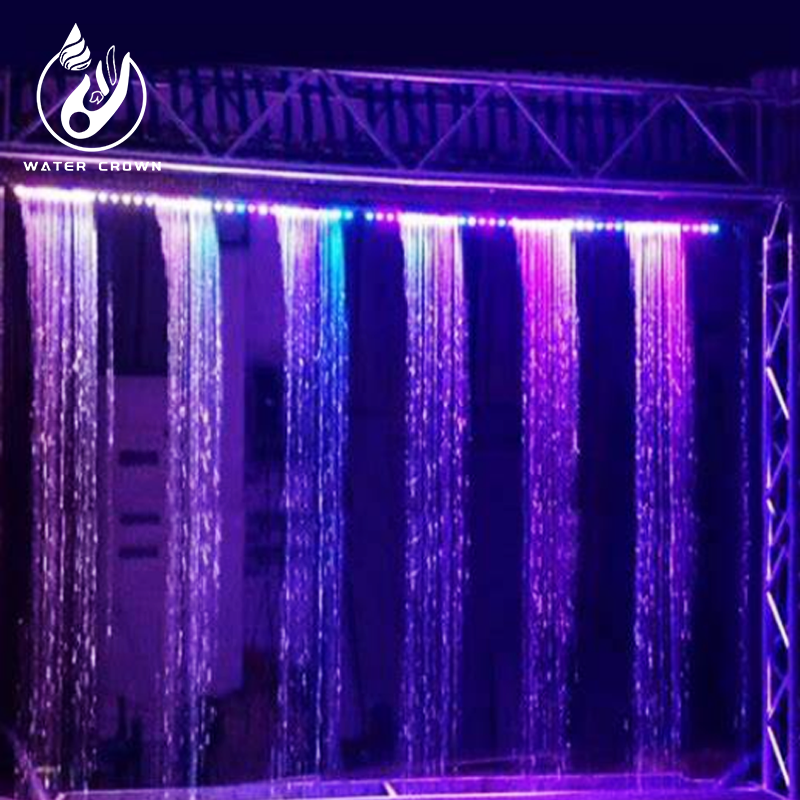
A custom curtain water feature, when engineered correctly, does something that few other architectural elements can pull off. It creates a physical and psychological boundary while remaining completely see-through. The water falls in a continuous sheet or in precisely programmed droplets, forming a vertical plane that people instinctively respect as a barrier. But unlike a wall, it doesn't break the sightlines that make an open plan work in the first place.
What Makes a Water Curtain Function as a Security Door
The mechanics are simpler than most people expect. A typical curtain water feature consists of a header tank with precision-machined nozzles, a catchment trough at the base, a recirculating pump system, and in many cases, a control panel that manages flow rate and pattern sequencing. The water falls under gravity in a laminar flow—meaning the streams stay parallel and coherent rather than breaking into mist or spray. That laminar quality is what gives the curtain its glass-like transparency.
For security applications, the engineering shifts from purely decorative to functional. Nozzle spacing gets tighter, usually down to 10 to 15 millimeters, so the water sheet has no gaps large enough for someone to slip through. Flow pressure gets calibrated to maintain integrity across the full drop height, which can range from two meters up to ten meters or more. The catchment system needs to handle the full volume without splashing, which means anti-splash baffles and properly graded troughs become critical.
One project in a Southeast Asian luxury hotel chain used a six-meter-high curtain water feature to separate the public lobby from a members-only lounge. The design called for the curtain to run continuously during operating hours and shut off only after the last guest left. The hotel reported zero unauthorized entries into the lounge over an eighteen-month period, and guest satisfaction scores for the lobby atmosphere actually increased. The water curtain became a talking point rather than an obstacle.
Installation Parameters That Determine Success
Getting a curtain water feature to function as a reliable security door starts with site assessment. Drop height dictates pump sizing—every meter of height adds roughly 10 kilopascals of head pressure requirement. For a four-meter drop, a pump pushing 1.5 to 2.0 cubic meters per hour per meter of width is a realistic baseline. Width matters just as much. A three-meter-wide opening needs different nozzle density and flow distribution than a one-meter-wide passage.
Water quality is another factor that gets overlooked in the planning phase. Hard water leaves mineral deposits on nozzles over time, which changes the jet pattern and can create weak spots in the curtain. A proper pre-filtration system—typically a combination of sediment filters and a water softener—extends maintenance intervals from monthly to quarterly. In one casino project in Macau, the maintenance team found that untreated water caused nozzle clogging within six weeks, while treated water kept the curtain running clean for over four months.
The structural load also deserves attention. A fully operational water curtain carries significant weight. A two-meter-wide curtain with a four-meter drop holds roughly 800 kilograms of water in circulation at any given moment. The header tank, support frame, and building attachment points all need to handle that dynamic load, plus the vibration from the pump system. Engineers typically spec stainless steel for all wetted components—304 grade is standard, though 316 gets specified for coastal installations or projects using treated pool water.
Comparing Water Curtains to Alternative Barrier Solutions
| Feature | Glass Wall | Roll-down Grille | Fabric Screen | Curtain Water Feature |
|---|---|---|---|---|
| Visual transparency | Full | None | Partial | Full |
| Physical deterrence | High | High | Low | Medium-High |
| Design statement | Minimal | Negative | Neutral | Strong |
| Installation cost (per m²) | $800–1,200 | $300–500 | $150–300 | $600–1,000 |
| Operating cost (annual) | $0 | $50–100 | $0 | $800–2,500 |
| Maintenance frequency | Low | Low | Medium | Medium |
| Space flexibility | Fixed | Fixed | Retractable | Retractable |
The numbers tell a clear story. A curtain water feature sits in the middle of the cost spectrum for installation but delivers a design impact that glass and metal simply cannot match. The operating cost is higher, no question about it—pumping water against gravity takes energy. But for projects where the aesthetic value justifies the expense, the water curtain offers a combination of transparency and security that no other solution provides.
Practical Considerations for Facility Managers
Running a curtain water feature as a security door introduces operational considerations that facility teams need to plan for. The pump system should have a backup unit or at least a bypass arrangement. If the primary pump fails during operating hours, the security barrier disappears. A simple A/B pump configuration with automatic failover adds about 15 percent to the equipment cost but eliminates that single point of failure.
Noise is another factor that catches people off guard. A poorly designed water curtain sounds like a bathroom shower running continuously—not exactly the atmosphere most premium spaces aim for. The fix lies in the catchment design. A deep trough with submerged outlet pipes and acoustic baffles cuts the falling water noise by a significant margin. In a recent installation at a high-end spa in Singapore, the acoustic treatment brought the sound level down from 65 decibels to 42 decibels at three meters distance, which is roughly the difference between a busy street and a quiet conversation.
The control system matters more than many realize. For security applications, the curtain needs to integrate with the building's access control or fire alarm system. If the fire alarm triggers, the water curtain should shut off immediately to allow for evacuation. If an access card reader grants entry, the curtain might part temporarily or shift to a different flow pattern. These integrations require careful coordination between the water feature supplier, the building management system integrator, and the security contractor.
When a Water Curtain Makes Sense—and When It Doesn't
Let's be direct about the limitations. A curtain water feature is not a hardened security barrier. It will not stop a determined intruder with tools or enough momentum. The water sheet offers psychological deterrence and visual demarcation, not physical resistance. For spaces that require true access control—think data centers, cash handling rooms, or high-security government facilities—a water curtain should never be the primary security measure.
Where it does work exceptionally well is in environments where the security requirement is about managing general public flow rather than stopping deliberate breaches. Hotel lobbies separating public from guest-only areas, restaurants cordoning off private dining rooms, retail stores creating VIP sections, and corporate offices designating executive floors—these are the sweet spots. The water curtain communicates "this area is different" in a way that most people respect without feeling excluded.
The return on investment calculation varies by project type. For a luxury hotel, the water curtain becomes part of the guest experience, something that gets photographed and shared on social media. That marketing value offsets the operating cost in a way that a roll-down grille never could. For a budget-conscious office building, the math looks different—the energy and maintenance spend might not justify the aesthetic gain.
Manufacturing and Quality Considerations
The performance of a curtain water feature depends heavily on the precision of its components. Nozzle machining tolerances, pump curve matching, and control valve response times all determine whether the curtain falls as a clean sheet or degrades into a splashing mess. Manufacturers with in-house machining capabilities tend to deliver more consistent results than those outsourcing critical parts. ISO and CE certifications provide a baseline for quality assurance, though they don't guarantee project-specific performance.
Water Crown has been manufacturing water feature components and swimming pool equipment since 2011, with a production footprint that includes dedicated machining for stainless steel nozzles and custom header fabrication. The company's experience in both decorative water features and functional pool equipment gives it a practical perspective on what works in real-world installations—not just what looks good in a showroom.
Table of Contents
- The Transparency Dilemma in Modern Commercial Spaces
- What Makes a Water Curtain Function as a Security Door
- Installation Parameters That Determine Success
- Comparing Water Curtains to Alternative Barrier Solutions
- Practical Considerations for Facility Managers
- When a Water Curtain Makes Sense—and When It Doesn't
- Manufacturing and Quality Considerations