
 EN
EN



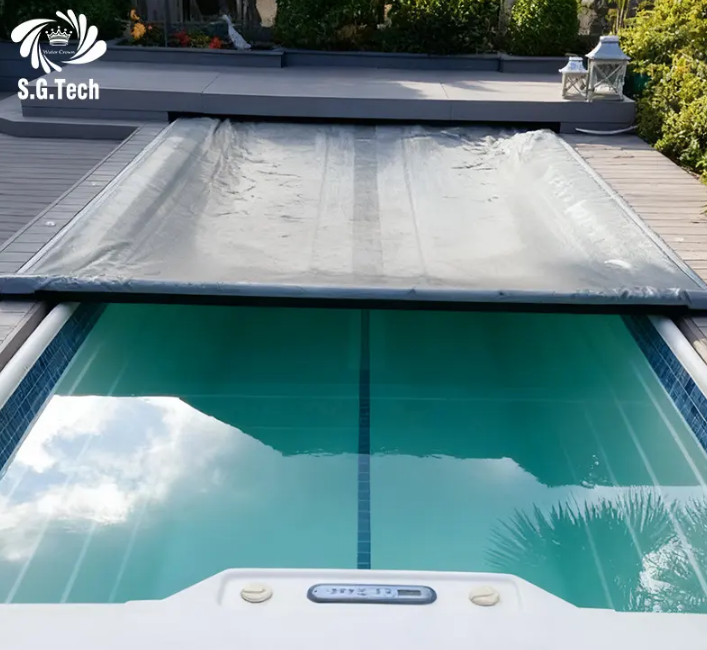
The Physics of Rain Load on a Pool Cover
Rainwater accumulation on a pool cover is a straightforward physics problem with potentially expensive consequences. A standard residential pool measuring 16 feet by 32 feet has a surface area of 512 square feet. One inch of rainfall over that area equals roughly 320 gallons of water, weighing about 2,700 pounds. A heavy storm dropping two to three inches can put 5,000 to 8,000 pounds of load on a cover that was never designed to bear that much weight.
The collapse mechanism is predictable: water pools in the center of the cover, the cover stretches, the center dips lower, more water flows to the low point, and the cycle accelerates until the cover fails or the supporting structure gives way. This isn't theoretical—anyone who's dealt with a sagging pool cover after a spring storm knows exactly what this looks like.
Drain Panels: The Engineering Solution
A pool cover with integrated drain panels addresses this problem at the source. Instead of allowing water to pool, drain panels create controlled pathways for water to exit the cover surface. The engineering principle is simple but effective: water flows to the lowest point, and the drain panel provides that low point with a route out.
These drain panels typically consist of a rigid frame with a grated or perforated surface, set into the cover material at strategic locations. Water flows through the grate, into a collection channel, and then through a drain line that carries it away from the pool area entirely. The key design consideration is positioning—drain panels need to be placed where water naturally collects, which usually means near the center of the cover or at the lowest points of the pool's geometry.
Field Data from a Southern Chinese Resort
A large leisure resort complex in Southern China operated two outdoor standard pools and one children's wading pool year-round. Before installing pool covers with integrated drainage, the facility faced persistent issues: rainwater accumulation on covers during monsoon season, heat loss overnight, and safety risks from open pools during non-operating hours.
After installing a fully automatic safety pool cover system with drain panels, the resort tracked performance over three months. Nighttime water temperature drop was reduced from approximately 5°C per night to less than 1.5°C. Evaporation dropped by about 90%, with daily refill volume falling from an average of 15 tons to less than 2 tons. The drain panels eliminated standing water on the cover surface entirely, removing the collapse risk that had previously kept the maintenance team on edge during heavy rain.
Types of Drain Panel Configurations
Not all drain panels are created equal. The configuration depends on the pool's shape, the local climate, and the cover's intended use.
| Drain Panel Type | Best Application | Drain Rate | Maintenance Requirement |
|---|---|---|---|
| Center-mounted grate | Rectangular pools, flat covers | High | Low |
| Perimeter channel | Freeform or irregular pools | Moderate | Moderate |
| Multi-panel array | Large commercial pools | Very high | Moderate |
| Mesh-integrated drain | Light-duty residential | Low | Low |
Center-mounted grates work well for standard rectangular pools where water naturally pools in the middle. Perimeter channels are better for freeform pools where the lowest points might be along the edges. Multi-panel arrays are typically reserved for commercial installations where rainfall volume is high and failure is not an option.
The ASTM F1346 Standard and What It Means
Pool safety covers in the United States are subject to ASTM F1346, which establishes performance requirements for covers intended to prevent accidental drowning. While this standard primarily addresses safety barriers and load-bearing capacity for human weight, it also influences how drain panels are designed and tested.
The standard requires that covers withstand specific static loads without failure. Drain panels must be integrated in a way that doesn't compromise the cover's structural integrity. A cover that passes ASTM F1346 testing has been verified to support the required weight load while maintaining its drainage function. For commercial pool operators, specifying covers that meet this standard provides a clear benchmark for safety and performance.
What Drain Panels Don't Do
It's worth being clear about limitations. Drain panels manage rainwater effectively, but they don't eliminate the need for periodic cover maintenance. Leaves, debris, and sediment can clog drain grates over time, reducing their effectiveness. Regular inspection and cleaning—especially after heavy storms—is still necessary.
Drain panels also don't address snow load. Snow is lighter per inch than water, but it accumulates and doesn't flow through drains the same way. For pools in northern climates, snow removal from covers remains a separate consideration. And drain panels won't prevent water from seeping through the cover material itself if the cover is porous or damaged—they only manage surface water that reaches the drain points.
The ROI of Drain-Equipped Pool Covers
The resort case study mentioned earlier provides a useful financial benchmark. After installing the cover system with drain panels, annual operating costs dropped by approximately 25% compared to the previous year. The investment payback period was estimated at within 15 months.
Most of the savings came from reduced water heating (less heat loss overnight), lower water usage (less evaporation and less refilling), and decreased chemical consumption (more stable water chemistry with the cover in place). The drain panels contributed indirectly by eliminating the labor and repair costs associated with rainwater-related cover damage. For facility managers, the math is straightforward: the cover system pays for itself within two pool seasons, and the drain panels are a critical part of that equation.
For pool owners and facility managers looking for reliable cover solutions, manufacturers like Water Crown offer systems that integrate drainage functionality with safety and energy efficiency—addressing the rainwater collapse risk while delivering measurable operational savings.