
 EN
EN



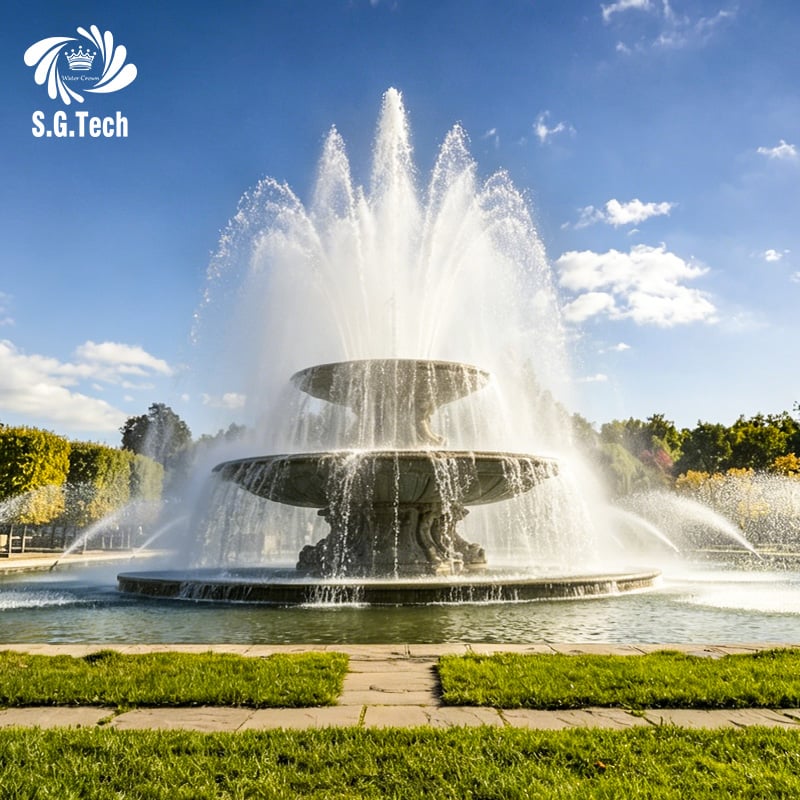
When Water Learns to Sing
A garden fountain used to be a simple thing: water rises, water falls, maybe a stone basin catches the splash. That is still pleasant, but the definition of outdoor ambiance has expanded. Musical fountains—systems that synchronize water movement with audio input—bring a layer of temporal experience that static water features cannot match. The water does not just flow; it responds. The rhythm changes with the track. The height of the jets follows the crescendo. The whole garden becomes a venue, not just a landscape.
The Audio-Water Integration That Makes It Work
The technical challenge of a musical fountain is not moving water—that part is straightforward. The challenge is timing. Audio signals have to be translated into control commands with minimal latency, because even a fraction of a second of delay breaks the illusion of synchronization. Most systems use a dedicated controller that analyzes the audio input—either from a local source or a streaming feed—and maps frequency, amplitude, and tempo to specific nozzle and lighting actions. Low frequencies might trigger taller jets or wider fans; high frequencies might produce rapid bursts or fine mist. LED color schemes can follow the same logic: warm colors for bass, cool colors for treble. The result is not a water show with background music. It is a performance where water and music are the same thing.
What the Research Says About Sensory Engagement
There is a reason musical fountains have proliferated in both public and private spaces. Multi-sensory environments—those that engage hearing and sight simultaneously—produce stronger emotional responses and longer memory retention than single-sensory stimuli. A fountain that combines visual movement with synchronized audio creates a focal point that draws attention and holds it. In garden settings, that translates to extended dwell time. People do not just walk past a musical fountain; they stop, watch, listen, and often return with others. For commercial properties—hotels, resorts, restaurants—that behavioral shift has direct revenue implications. For residential gardens, it changes how the space is used and enjoyed.
| Feature | Static Fountain | Musical Fountain |
|---|---|---|
| Sensory Engagement | Visual only | Visual + Audio |
| Programmability | None | Full |
| Evening Appeal | Moderate (with lighting) | High (synced lighting) |
| Seasonality | Year-round | Year-round (with winterization) |
The Garden Installation That Redefined a Property
A high-end residential property in the southwestern U.S. had a large garden that felt underutilized. The owners hosted events regularly, but guests tended to cluster indoors or on the patio rather than exploring the garden. The landscape architect recommended a musical fountain as the anchor for a new garden room—a seating area arranged around the water feature. The system was designed with a modest footprint: a small basin, a compact pump assembly, and a controller with a pre-loaded library of classical and ambient tracks. The fountain could run in automatic mode, cycling through the playlist, or in manual mode for events. Within three months, the garden had become the preferred gathering spot for evening events. Guests commented on the fountain unprompted. The owners reported that they used the garden more frequently themselves. The fountain did not just add sound to the space—it gave the space a reason to be occupied.
The Practical Realities of Outdoor Audio
Sound in an outdoor environment behaves differently than indoors. There are no walls to contain it, no ceilings to reflect it. Wind carries it away. Ambient noise—traffic, birds, neighboring properties—competes with it. A musical fountain has to overcome these conditions with adequate amplifier power and speaker placement. The speakers themselves need to be weather-rated; consumer-grade outdoor speakers will not survive a few seasons of rain, heat, and cold. Some systems use directional speakers to keep sound concentrated in the seating area rather than broadcasting it to the neighbors. Others use lower overall volume with closer speaker placement, relying on proximity rather than power. The right approach depends on the site, but the rule is consistent: plan the audio system with the same rigor as the water system, or the performance will disappoint.
Where Musical Fountains Make Sense—And Where They Do Not
Musical fountains are not a universal upgrade. In settings where quiet is the primary value—meditation gardens, nature preserves, quiet residential neighborhoods—adding amplified music may be counterproductive. The sound, even at low volumes, changes the character of the space. There is also the question of repetition. A playlist that loops the same tracks day after day will eventually become background noise rather than a feature. The solution is variety: either a large enough library to avoid repetition, or a system that can accept new input from a connected device. Maintenance is another factor. The pump, nozzles, and lighting all need regular attention, and the audio components add another layer of potential failure points. These are not deal-breakers, but they are considerations that should inform the decision.
The Integration of Water and Audio Systems
A musical fountain is two systems—water and audio—that have to work as one. The water side handles flow, pressure, and nozzle control. The audio side handles signal processing, amplification, and speaker output. The controller sits between them, translating audio into actuation. That integration requires manufacturing capabilities that span both domains. Guangdong Water Crown Environmental Technology produces swimming pool equipment and musical fountain systems under the same roof. That cross-domain production means the water components and the audio components are designed with each other in mind, not bolted together after the fact. For a garden owner or a landscape architect, that integration is what separates a reliable installation from a troubleshooting nightmare.
Table of Contents
- When Water Learns to Sing
- The Audio-Water Integration That Makes It Work
- What the Research Says About Sensory Engagement
- The Garden Installation That Redefined a Property
- The Practical Realities of Outdoor Audio
- Where Musical Fountains Make Sense—And Where They Do Not
- The Integration of Water and Audio Systems