
 EN



The Real-Time Dilemma of Modern Musical Fountains
Designing world-class public water shows requires absolute synchronization between auditory signals and hydraulic choreography. When an audience experiences a grand music fountain, every crescendo, bass drop, and vocal note must match the physical eruption of water jets down to the exact millisecond. In standard computing environments, operating systems handle background background tasks, user interfaces, and network packets through dynamic resource scheduling, which introduces unpredictable timing jitter. For a complex music fountain, even a minuscule delay of fifty milliseconds between the audio track and the mechanical valve actuation ruins the artistic illusion, making the water display feel disjointed and sluggish. To overcome this challenge, modern control engineering turns away from consumer operating systems and relies on specialized architectures to guarantee absolute deterministic timing across every single node.
How Real-Time Operating Systems Eliminate Jitter
A standard general-purpose operating system treats music playback and mechanical control commands as competing threads that share processor cycles dynamically. Under heavy load, these background routines create processing latency that causes erratic valve responses in a music fountain. In contrast, a Real-Time Operating System (RTOS) utilizes deterministic task scheduling, strict priority-based preemption, and bounded execution times. In an RTOS-driven music fountain network, high-priority tasks dedicated to audio signal analysis and DMX valve actuation are guaranteed processor access within predictable microsecond windows. This eliminates timing jitter entirely, ensuring that the physical movement of the water column mirrors the sound wave with flawless mathematical precision, regardless of how many auxiliary lighting or diagnostic routines run in the background.
Audio Frequency Analysis and Signal Translation Pipelines
Synchronizing water dynamics with sound requires a sophisticated digital signal processing (DSP) pipeline that must operate in real time. As music plays, a high-performance music fountain controller samples the audio stream, routing the signal through Fast Fourier Transform (FFT) filters to separate frequencies into distinct channels—such as deep bass sub-woofers, mid-range melodies, and high-pitched vocal harmonies. Each frequency band translates instantly into precise mechanical coordinates, commanding variable-frequency drives (VFDs) and high-speed solenoid valves. Because this translation happens continuously at sampling rates exceeding thousands of hertz, a standard operating system would inevitably drop packets or lag. An RTOS guarantees that this heavy computational load executes without interruption, allowing the music fountain to interpret complex musical arrangements and convert them into fluid motion instantaneously.
Distributed Network Architecture and Low-Latency Fieldbuses
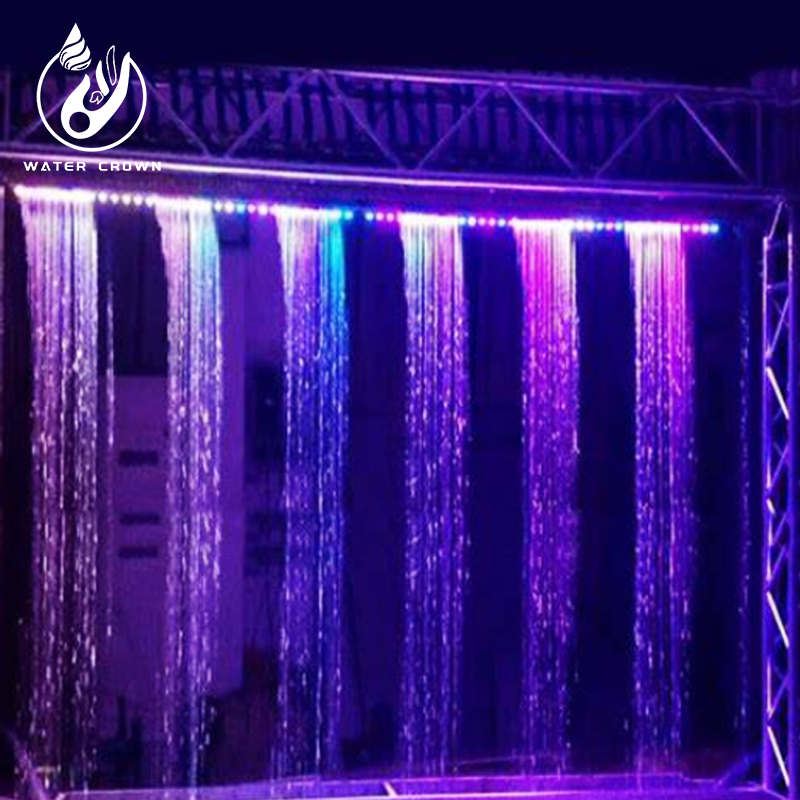
A modern commercial installation features hundreds of movable nozzles, submerged LED fixtures, and digital water curtains spread across a massive aquatic basin. Managing this scale requires a distributed control architecture where a master controller communicates with decentralized sub-controllers via industrial fieldbuses like EtherCAT, PROFINET, or DMX512-A. Within this networked music fountain environment, communication delays between the central processor and remote valve actuators must approach absolute zero. An RTOS provides the underlying network stack optimization required to packetize and transmit control commands over Ethernet without buffering delays. This ensures that a nozzle located fifty meters away reacts at the exact same instant as a nozzle positioned right next to the control room, preserving the visual integrity of wave patterns and sweeping arcs.
Reliability, Hardware Safety, and Industrial Manufacturing Standards
Beyond pure artistic precision, managing high-pressure pumps and heavy mechanical valves in an open public square demands unwavering system reliability and fault tolerance. A system crash or kernel panic in a standard operating system during a live show would freeze the water choreography or cause dangerous hydraulic water hammer effects. Industrial-grade control systems running on an RTOS provide deterministic fault recovery, watchdog timers, and hardware-level safety interlocks. Leading aquatic engineering enterprises, such as Water Crown, integrate these robust real-time control frameworks with premium-grade mechanical hardware, durable SS304/SS316 stainless steel structures, and complete OEM/ODM manufacturing standards. By combining advanced RTOS software engineering with precision-crafted fountain equipment, developers deliver exceptionally reliable, zero-latency music fountain installations that captivate audiences safely year after year.